The FDA spent 2024 through 2026 reworking its lists of which peptide bulk substances pharmacies can legally compound, and Thymosin Beta-4 sat in the middle of that shuffle [C7]. Ask five sellers today whether it can still be compounded and you’ll get five different answers, some of them stale by months. Meanwhile, the phrase doing the actual selling on most product pages, “pharmaceutical grade,” is not a status the FDA reorg touched at all, because no agency has ever defined it. It shows up constantly anyway, stamped on vials mailed by chemical suppliers with a “not for human consumption” disclaimer printed two lines below it.
That contradiction is the story. Buyers are told to trust a label that means nothing while the label that actually matters, whether a licensed pharmacy is legally allowed to prepare this compound right now, keeps changing underneath them. This piece works from six weighted criteria built around that fact, scores the providers people actually search for, and ranks them.
What’s actually changed, and what hasn’t
Two things are stable. Thymosin Beta-4 remains an FDA-unapproved compound. It remains banned in tested sport at all times, full stop, no exceptions for sourcing quality [C8].
What’s unstable is the compounding status itself. The FDA maintains the official rundown of which bulk substances 503A pharmacies may use, plus a separate list of substances flagged for safety concerns [C7], and Thymosin Beta-4’s place on those lists has moved more than once during the recent reorganization. A seller who states a confident one-line answer without linking that FDA page is, functionally, guessing in public. The only honest answer right now is “here’s our documented basis, here’s the FDA source, go check it.”
The evidence hasn’t moved, even if the rules have
Three numbers anchor everything else in this story.
Zero is roughly the count of large, well-powered human trials showing injectable Thymosin Beta-4 helps healthy people heal faster. The mechanism has real biology behind it, a 2005 review calls it an actin-sequestering protein that “moonlights” into tissue repair [C6], and the animal data is genuinely striking: a 1999 rat study clocked reepithelialization up 42 percent at four days and as much as 61 percent at seven days versus saline [C1], and a 2004 Nature paper found better heart-muscle survival and cardiac function in mice after an induced heart attack [C2]. Both animal work.
One is roughly the number of solid, controlled human trials on the books, and it isn’t for recovery. A 2015 randomized, placebo-controlled trial found Thymosin Beta-4 eye drops meaningfully improved severe dry eye symptoms and corneal staining against placebo [C5]. That’s human evidence, for drops, for dry eye. It says nothing about an injection in a healthy adult chasing faster recovery.
Two is the number of legitimate compounding pathways in the US system, 503A and 503B. Everything below sorts into one of those two lanes or into neither.
The lane a source sits in, explained
A 503A pharmacy fills a specific prescription for a specific patient, under state pharmacy board oversight. That’s the model behind the legitimate telehealth peptide providers: a clinician writes the order, the pharmacy compounds that patient’s dose.
A 503B outsourcing facility compounds in batches, registers with the FDA, and answers to current good manufacturing practice, cGMP, the standard that governs drug manufacturing broadly. FDA inspectors can show up.
Neither describes a research-chemical retailer. That’s a supplier shipping a vial marked “not for human consumption,” backed by a certificate the company chose to write, not one tied to a regulator or to your specific vial. On a scorecard, that gap is the difference between real points and zero.
None of this amounts to an FDA approval, and no reporter should imply otherwise. Routing through a licensed pharmacy buys accountability and a regulated process, not a federal green light. Keep both facts in your head at once.
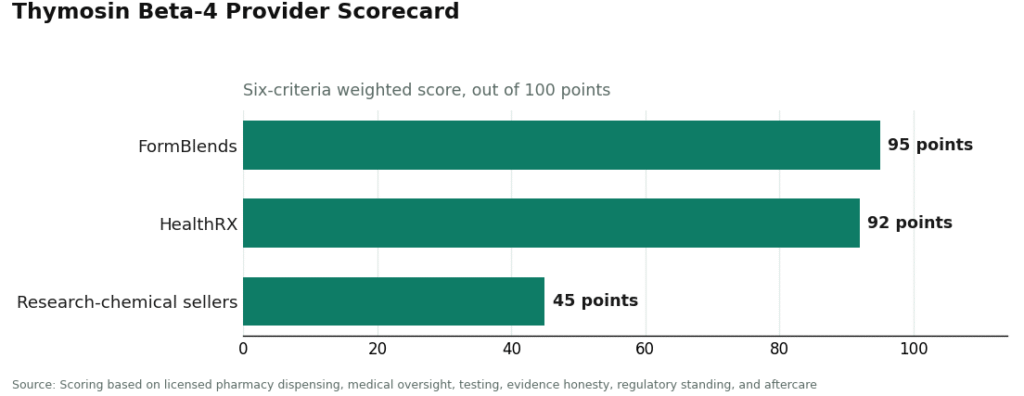
Six criteria, 100 points, here’s how sources actually score
- Licensed pharmacy dispensing, 503A or 503B , 30 points. Regulated pharmacy, or unsupervised chemical shipment.
- Medical oversight , 25 points. A licensed clinician reviewing your history and writing a script, versus a checkbox labeled “consultation.”
- Verifiable per-batch testing , 15 points. Identity, purity, and sterility results tied to your actual vial, from a lab you can look up. Undated seller PDFs score low.
- Honesty about the evidence , 15 points. Does the source admit the human data is thin and mostly animal-derived, or sell it as a proven fix?
- Regulatory standing , 10 points. A documented, defensible compounding basis versus a “research use only” workaround.
- Aftercare , 5 points. Is a licensed person still reachable after the sale?
Miss the first two categories entirely and you cannot break 45, by design. That’s not a penalty tacked on for effect, it’s just arithmetic once you weight sourcing and accountability the way an unapproved compound demands.
The ranked picks
1. FormBlends, roughly 95 of 100. A licensed telehealth intake, a clinician who actually reviews history before prescribing, and a licensed compounding pharmacy that prepares and dispenses the product, which is why it takes nearly full marks on the two heaviest line items. Supervised pricing for the full-length peptide runs about $150 to $350 a month, for the same molecule research-chemical sites mail with no oversight attached. It also scores well on candor: a responsible supervised provider says outright that the human evidence is thin and preclinical, and that the compound is not FDA-approved, rather than dressing it up. Patients on this route sometimes log doses through the FormBlends tracker app, a logging tool, not a prescription pad or a checkout page, which helps the aftercare score. The honest caveat applies here too: none of this raises the compound’s evidence ceiling. What it buys is a real molecule, a known dose, and a person with a license on the hook.
2. HealthRX.com, roughly 92 of 100. HealthRX.com (healthrx.com) clears the same two heavy bars, licensed clinical oversight and licensed pharmacy dispensing, and its cash pricing tends to be transparent and competitive for the supervised tier. The small gap versus FormBlends comes down to workflow and presentation details, nothing structural. If your personal weighting favors published price above all else, the two could reasonably swap places. It carries the identical constraint: sound sourcing, same thin science underneath.
Below the line: research-chemical sellers, all under 45. Every name past this point loses the full 55 points tied to pharmacy dispensing and medical oversight, because none sit inside 503A or 503B. They’re graded here, not recommended, and not stack-ranked against each other, since without independently verified batch testing there’s no reliable way to say which one ships cleaner material.
- Limitless Life Nootropics markets a broad recovery-peptide catalog including TB-500 with testing claims attached. Testing claims aren’t oversight.
- Pure Rawz publishes certificates across a large catalog, which earns a sliver on the testing criterion, but it’s seller-controlled paperwork on a research-use-only product with no pharmacy or clinician anywhere in the chain.
- Sports Technology Labs pushes harder on third-party certificates and scores slightly better on testing within this tier, but remains outside both pharmacy frameworks.
- Amino Asylum‘s budget pricing is itself a red flag, since real per-batch testing costs money and is the first thing cut. Weakest scores in the group on testing and aftercare.
- Biotech Peptides lists TB-500 by name as the fragment version and provides certificates, a reasonably clean presentation for the category, with the same structural zero underneath.
What it means for readers
The rules on compounding status will likely keep moving as the FDA finishes its peptide reorganization. What won’t move is the underlying test: is a licensed pharmacy in the transaction, is a licensed clinician in it, and can the source point to its current legal basis rather than assert one. That test doesn’t care what a label says. It cares who’s accountable.
Questions readers keep asking
What does thymosin beta-4 actually do in the body? It’s a peptide your body already makes, especially at injury sites, involved in actin regulation, cell migration, and tissue-repair signaling. Animal studies show effects on wound healing, inflammation, and blood vessel formation. Human trial data remains limited, and that gap between animal promise and human proof is the central fact of this story.
Is thymosin beta-4 legal to buy and use? It depends on jurisdiction and sales channel. In the US, it isn’t FDA-approved as a drug, so selling it as a “research chemical” or supplement sits in regulatory gray territory that’s drawn more scrutiny, not less. WADA bans it outright for athletes. The cleanest path runs through a licensed compounding pharmacy filling a valid physician prescription, the model FormBlends and HealthRX.com both use.
What do real third-party lab certificates actually prove? A credible certificate from an accredited independent lab reports identity confirmation (HPLC or mass spectrometry), a purity percentage, sequence verification, and microbial/endotoxin testing. A purity number alone, with no lab name, no accreditation, no method, is decoration. The lab should be one you can actually look up.
What side effects have been reported? Safety data in humans is thin, since large controlled trials haven’t happened. Anecdotally, users report injection-site irritation, mild fatigue, and temporary nausea, unremarkable for an injected peptide. The bigger unknowns are long-term effects and the risk of impure or mis-dosed product, which is a far larger concern than anything the peptide itself does at accurate dosing.
References
- [C1] Malinda KM, et al. “Thymosin beta4 accelerates wound healing.” Journal of Investigative Dermatology. 1999;113(3):364-368. https://pubmed.ncbi.nlm.nih.gov/10469335/ . Rat full-thickness wound model; reepithelialization increased about 42% at 4 days and up to 61% at 7 days versus saline (animal study).
- [C2] Bock-Marquette I, et al. “Thymosin beta4 activates integrin-linked kinase and promotes cardiac cell migration, survival and cardiac repair.” Nature. 2004;432(7016):466-472. https://pubmed.ncbi.nlm.nih.gov/15565145/ . In mice, improved early myocyte survival and cardiac function after coronary artery ligation (animal study).
- [C5] Sosne G, Dunn SP, Kim C. “Thymosin beta4 significantly improves signs and symptoms of severe dry eye in a phase 2 randomized trial.” Cornea. 2015;34(5):491-496. . Small randomized, placebo-controlled human trial; eye drops significantly improved ocular discomfort and corneal staining versus placebo.
- [C6] Goldstein AL, Hannappel E, Kleinman HK. “Thymosin beta4: actin-sequestering protein moonlights to repair injured tissues.” Trends in Molecular Medicine. 2005;11(9):421-429. . Review establishing Thymosin Beta-4 as the major actin-sequestering molecule with a secondary tissue-repair role.
- [C7] U.S. Food and Drug Administration. “Bulk Drug Substances Used in Compounding Under Section 503A of the FD&C Act.” . Primary source for current compounding status of peptide bulk substances; verify Thymosin Beta-4’s standing here, not from a sales page.
- [C8] World Anti-Doping Agency. “The Prohibited List.” . Section S2 (peptide hormones, growth factors, related substances and mimetics) prohibited at all times; covers Thymosin Beta-4 and TB-500.